

You can buy all the right furniture and still walk into a room that feels flat. Cold, somehow. Unfinished. Pottery Barn-style rooms do the opposite — nothing fancy, just comfortable furniture, warm neutrals, natural materials, and layers that build up slowly, the way a real home does. The good news? You don’t have to start over. A better rug. Softer textiles. One solid wood piece. Lighting chosen on purpose instead of by default. Any one of those can shift the whole mood. These Pottery Barn living room ideas put the pieces together in practical ways, whether you’re working with a big family room, a compact apartment, or a neutral space that just needs refreshing.
In This Article
- Start With a Relaxed Slipcovered Sofa
- Layer Creamy Neutrals for a Cozy Look
- Bring in a Substantial Wood Coffee Table
- Use a Classic Area Rug to Define the Seating Zone
- Add Woven Baskets for Texture and Storage
- Create a Fireplace Focal Point
- Mix Linen, Cotton, and Chunky Knits
- Pair Traditional Pieces With Modern Comfort
- Make the Windows Feel Softer With Linen Curtains
- Use Oversized Artwork Instead of Many Small Pieces
- Add a Comfortable Leather Accent Chair
- Style Built-In Shelves With Breathing Room
- Warm Up the Room With Aged Brass Lighting
- Create a Family-Friendly Cozy Corner
- Use Symmetry for a More Polished Layout
- Give a Small Living Room a Pottery Barn Feel
- Finish With Collected, Personal Details
- Get the Pottery Barn Look for Less
- Size Guide: Rug, Sofa and Curtains
- Mixing in Mid-Century Pieces
- Frequently Asked Questions
1. Start With a Relaxed Slipcovered Sofa

Start with the sofa, because that’s where the whole room takes its cue. A big slipcovered sofa — ivory, oatmeal, warm beige, soft greige — is the fastest way to get that comfortable, unfussy Pottery Barn living room character. Pile on cushions in linen, cotton, or something subtly woven, and keep the furniture around it chunky but simple. The sofa should be the anchor, not one more thing competing for attention. And in a family room, that’s the whole point: slipcovers and relaxed fabrics don’t ask anyone to be careful. Kids, dogs, Sunday naps — the room takes it all and still feels welcoming, not precious.
Quick Win: Before you buy anything new, try two textured throw pillows and one casually folded blanket on the sofa you’ve already got. Sometimes that’s all it takes.
2. Layer Creamy Neutrals for a Cozy Look
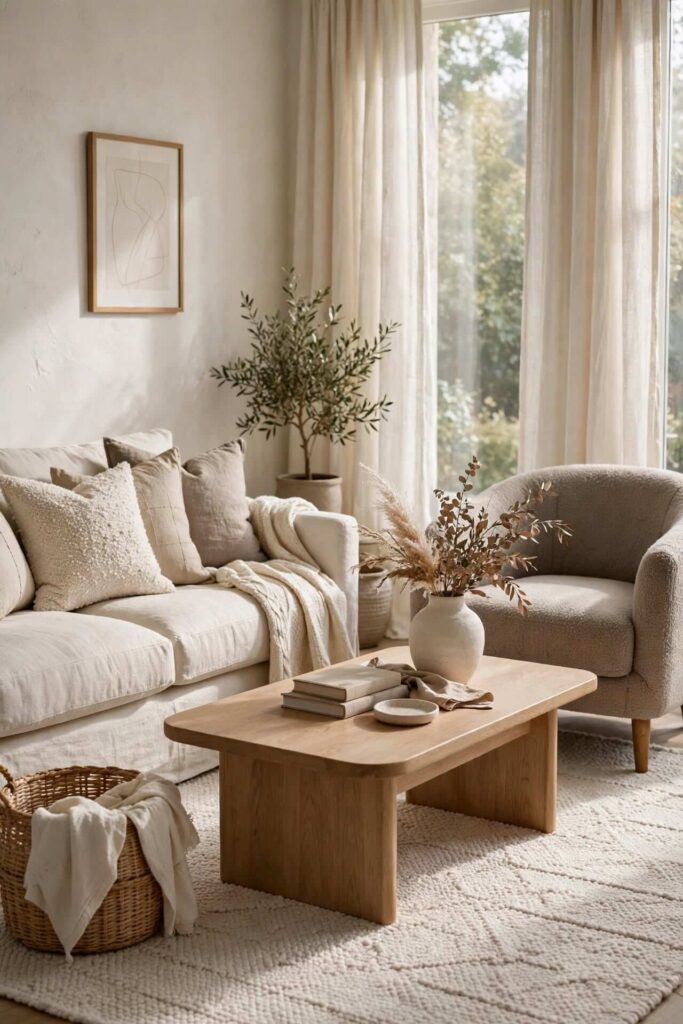
Pottery Barn rooms feel warm for a simple reason: nobody used one flat color and called it done. Creamy white walls, beige upholstery, an ivory rug, taupe cushions, warm wood — a handful of shades sitting close together. Those small shifts in tone are what stop a neutral room from looking sterile. And the depth doesn’t come from color at all. It comes from mixing finishes and textures — a matte wall next to a nubby cushion next to smooth wood — so the room has something for your eye to land on even when the palette stays quiet.
3. Bring in a Substantial Wood Coffee Table
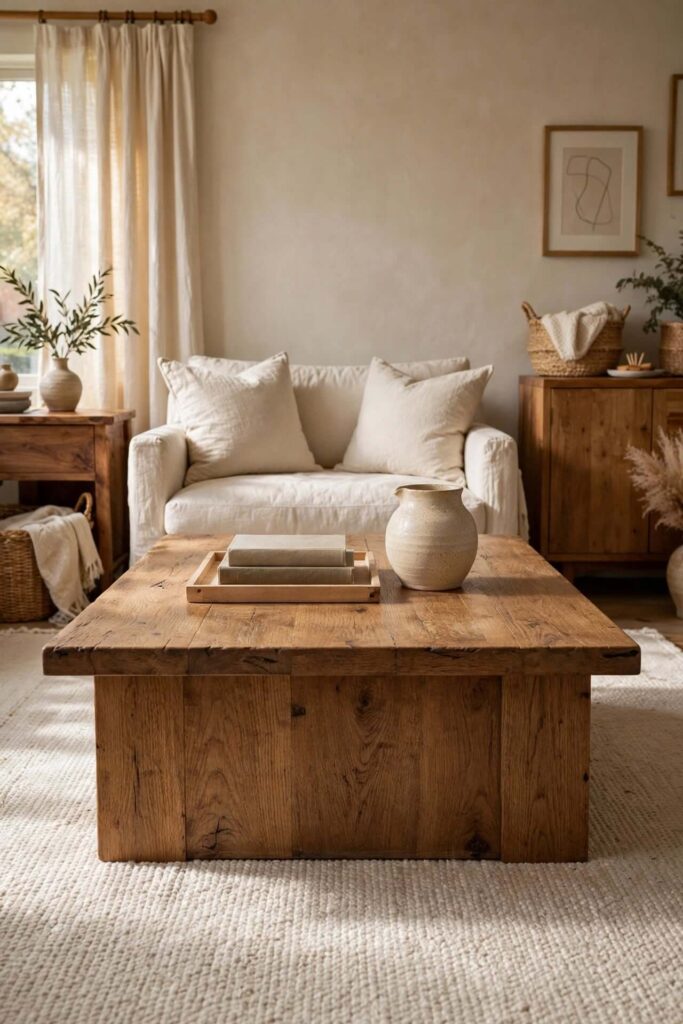
A soft neutral room can drift. Everything pale, everything light — and suddenly nothing holds the eye. That’s where a chunky wood coffee table earns its keep. Natural oak, reclaimed wood, medium walnut with the grain showing — anything but a high-gloss finish. Size matters here: big enough to feel like it belongs with the sofa, but not so big you’re shuffling sideways around it. Style it simply — a wooden tray, a ceramic vessel, a couple of books — and let it do its job. When a Pottery Barn living room needs warmth but no more color, a solid wood table is usually the fastest fix.
Quick Win: Coffee table feeling too small? Set a larger rectangular tray on top. It reads as a bigger footprint without buying a new table.
4. Use a Classic Area Rug to Define the Seating Zone
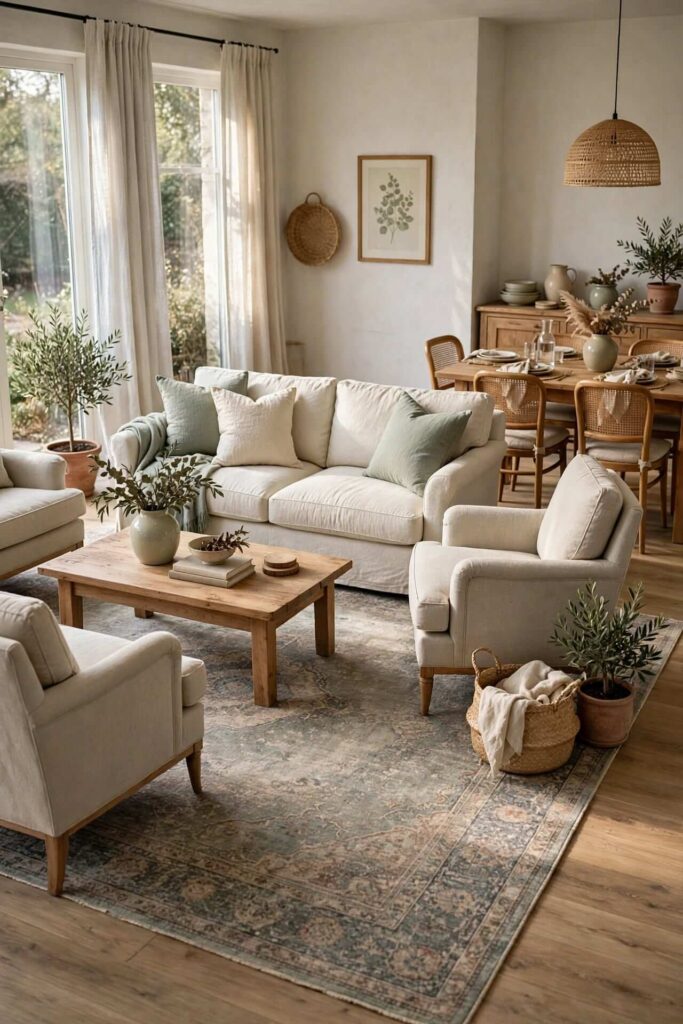
A rug is the fastest way to make a living room look like someone thought about it. It pulls the furniture into one group and tells you where the seating zone starts and ends. For a Pottery Barn-inspired room, look at faded traditional patterns, muted Persian-style designs, soft geometrics, or a solid textured rug in cream or taupe. Whatever you pick, make it big enough to slide under the front legs of the main seating — that’s what connects the pieces visually. In an open-plan home it does a second job, too: it marks out the living area without a single wall.
5. Add Woven Baskets for Texture and Storage
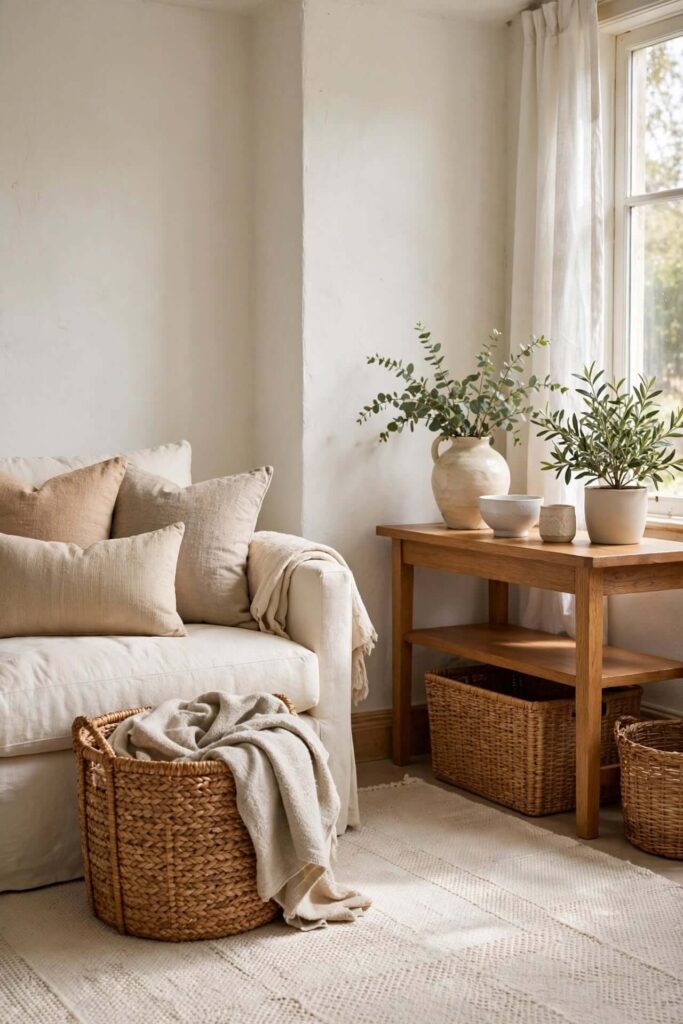
Baskets are the easy win nobody regrets. One big one beside the sofa for blankets, a smaller one tucked under a console, a pair by the fireplace to balance things out — and suddenly the room has the natural texture that makes a cozy living room feel layered instead of flat. Seagrass, rattan, jute, water hyacinth — they all sit happily next to cream upholstery and wood. And they’re storage, too, the kind that doesn’t look like storage. Nothing in the room screams “organized.” It just quietly is.
6. Create a Fireplace Focal Point
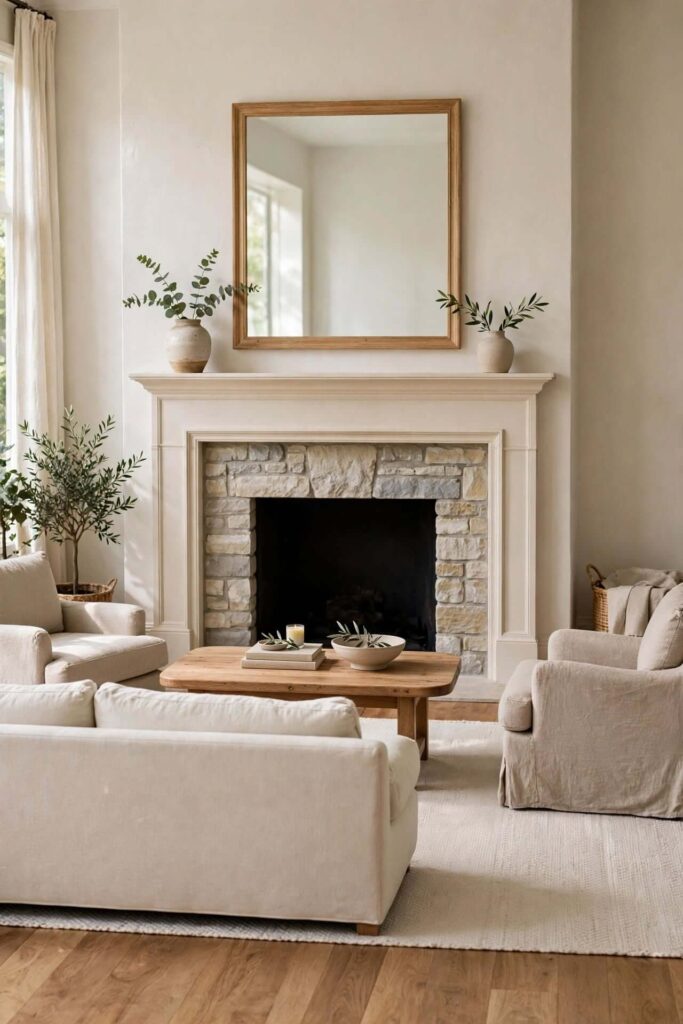
Got a fireplace? Let it run the room. A simple painted mantel, a natural stone surround, warm brick — any of those gives you the classic bones of a Pottery Barn-style room, so stop fighting it and arrange everything else around it. On the mantel itself, less is more: a mirror or one oversized piece of art, a ceramic vessel, maybe a couple of quiet objects, and done. Then point the seating toward the fire. A room arranged around a fireplace just feels conversational — people face each other instead of the television.
Quick Win: Clear the mantel down to one large mirror or artwork and two low-profile accessories. Fewer, bigger pieces always look more intentional than a row of small ones.
7. Mix Linen, Cotton, and Chunky Knits
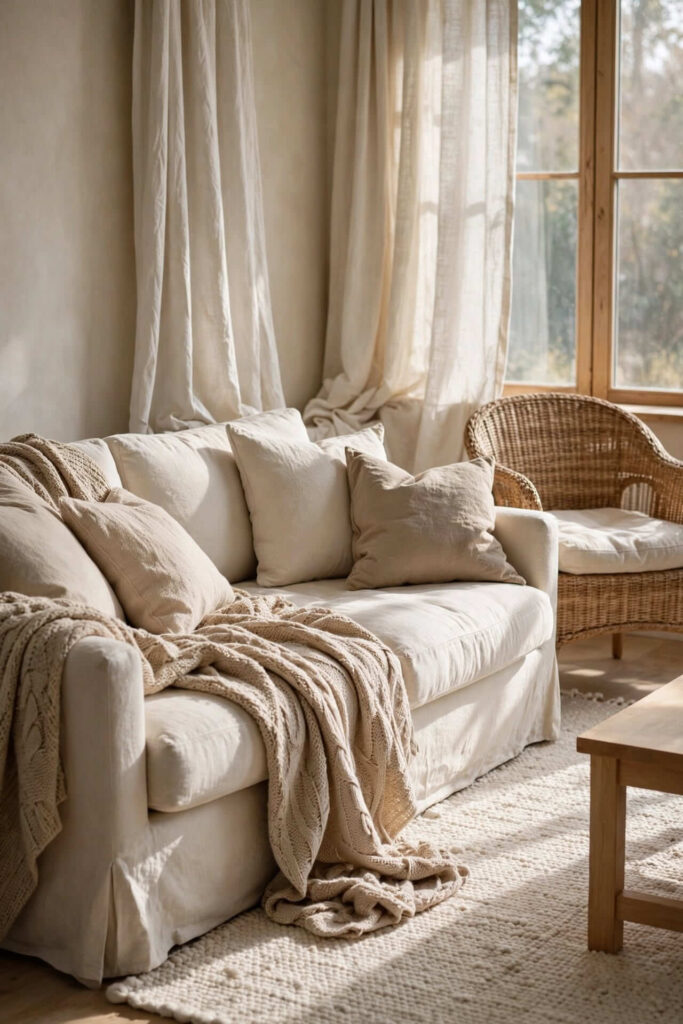
With a quiet palette, texture does the talking. Skip the extra ornaments and layer instead — linen curtains, cotton cushions, a woven throw, a chunky knit blanket, a rug you can feel underfoot. The materials give you contrast without adding color, and the room stays comfortable. One rule of thumb: pick two or three textures and repeat them around the room. A different material on every surface just turns into noise. In a neutral room that’s crying out for personality, texture is usually what’s missing.
8. Pair Traditional Pieces With Modern Comfort

You don’t need a museum of antiques to get the Pottery Barn look. A classic wood console here, a vintage-style rug there, a framed landscape on the wall — then a streamlined sofa and some contemporary lighting to keep it current. The mix is the point. Too traditional and the room feels dated; too modern and it loses its warmth. And if your furniture already comes from different eras, this is good news: you don’t have to replace it all. The contrast is what makes it feel like everything belongs together.
9. Make the Windows Feel Softer With Linen Curtains

Curtains change a room more than people expect. Floor-length linen — or linen-look, nobody will know — in ivory, oatmeal, or warm white, and suddenly the room has height, movement, and a softer edge. Hang the rod a little above the window frame and let the panels fall all the way to the floor. In a smaller room this trick earns its keep twice over: the long vertical lines make the ceiling feel taller, and the light fabric keeps everything airy.
Quick Win: Hang the curtains closer to the ceiling instead of directly above the window — the room reads taller and more finished straight away.
10. Use Oversized Artwork Instead of Many Small Pieces

One big piece of art beats a gallery wall of small ones. A muted landscape, a neutral abstract, a vintage-style botanical print, an oversized black-and-white photograph — pick one and give it room. Above the sofa or the console, with minimal accessories around it, it becomes the focal point the whole room organizes itself around. Scale does something funny, too: a large frame makes even ordinary furniture look more deliberate, more substantial.
11. Add a Comfortable Leather Accent Chair
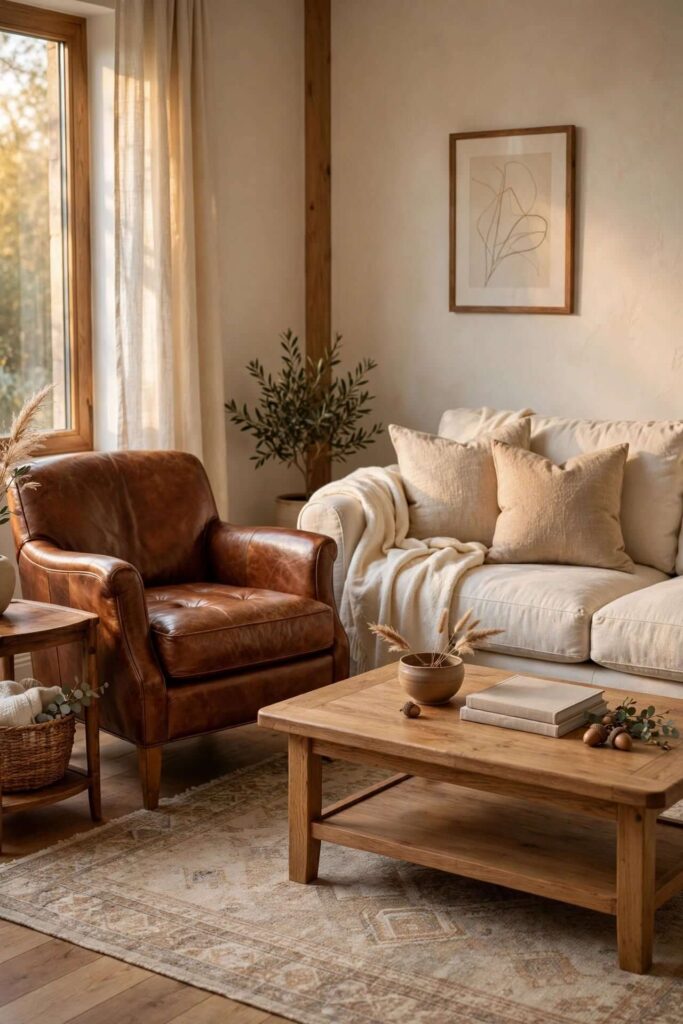
A neutral room needs one thing with a bit of weight to it, and a cognac or warm brown leather chair is the classic answer. The color sits beautifully against ivory sofas, natural wood, woven textures, and vintage-style rugs. Keep the shape relaxed — nothing too stiff or formal — and soften it with a neutral throw or a small cushion. It’s the easiest way to add contrast when you don’t want a bold accent color anywhere near the room.
12. Style Built-In Shelves With Breathing Room
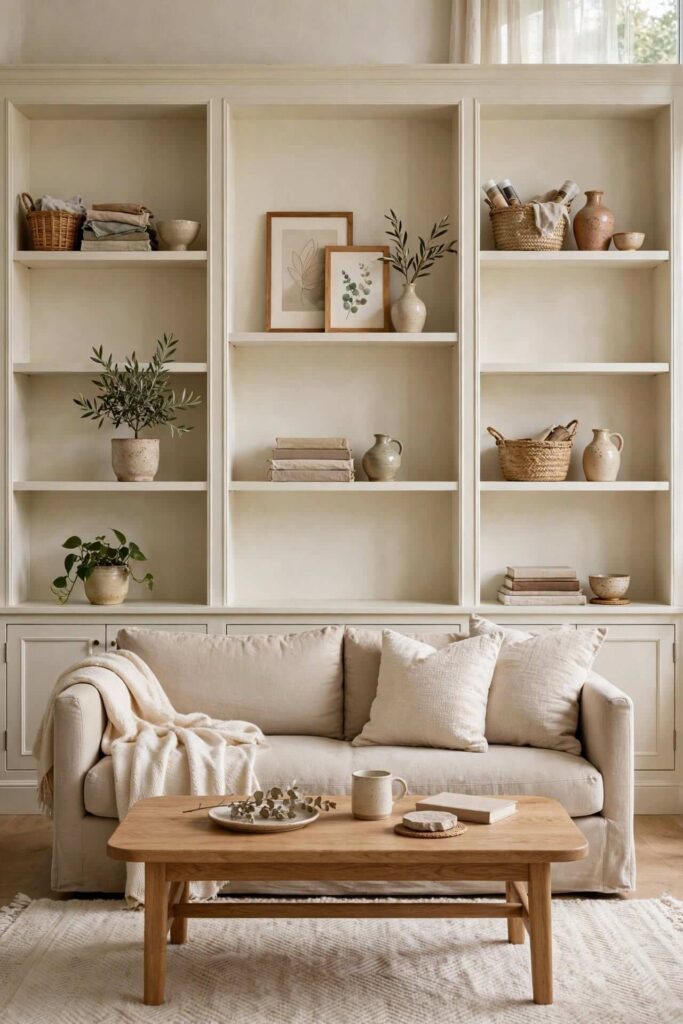
Built-ins look best when they aren’t stuffed. Start with the bigger pieces — large books, baskets, pottery, framed art, a few objects that actually mean something — and then stop. Leave some shelves partly empty. That breathing room is what makes the whole thing look considered instead of crammed. Keep the colors in the same family as the rest of the room — natural wood, cream, black, earthy tones — and the shelves tie themselves together. Storage and a visual feature, in one wall.
Quick Win: Take a third of the objects off your crowded shelves. Then regroup what’s left by height, texture, and color — you’ll be surprised how much calmer it looks.
13. Warm Up the Room With Aged Brass Lighting
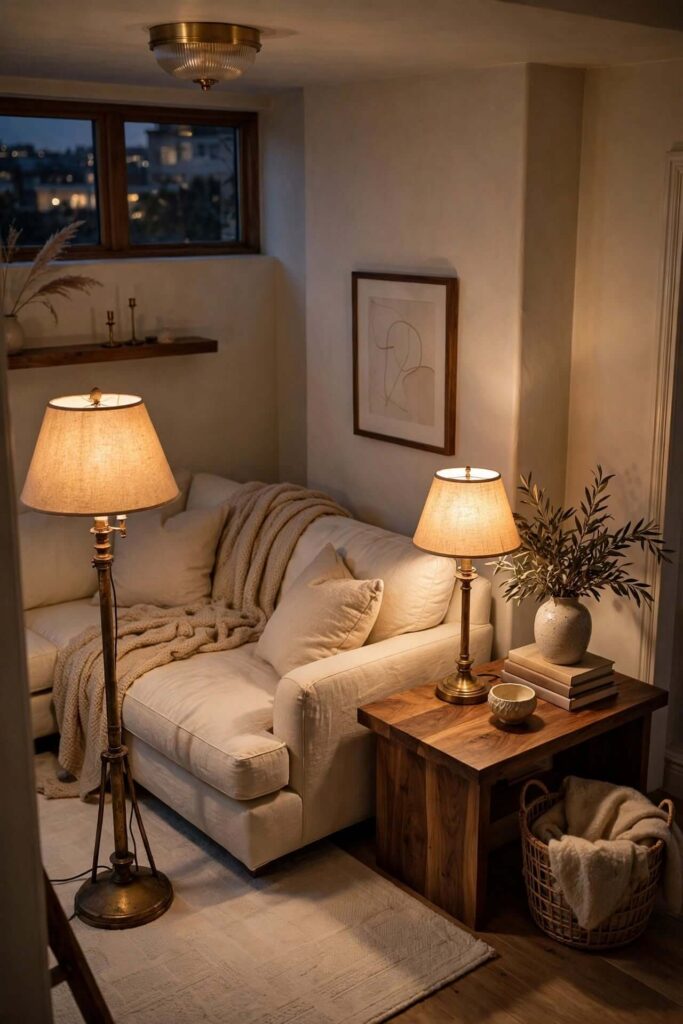
After sunset, lighting does more work than any piece of furniture. Aged brass, antique brass, warm bronze — on table lamps, floor lamps, sconces, or a chandelier-style fixture — and the whole neutral palette warms up by a few degrees. Pair the metal with linen shades and warm-white bulbs, or the light goes harsh. And don’t lean on one ceiling fixture. Several small sources at different heights — a lamp here, a sconce there — is what gives a Pottery Barn living room that soft, layered evening glow.
14. Create a Family-Friendly Cozy Corner
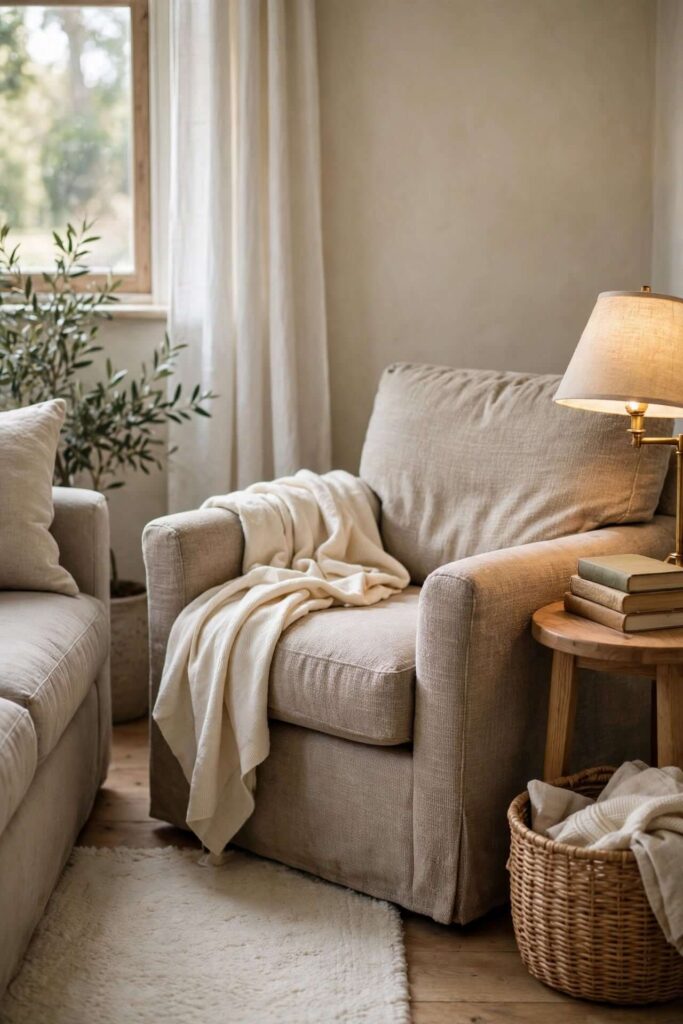
A Pottery Barn-inspired living room doesn’t have to be precious. Build one corner for real life: a deep armchair, a throw you can actually wash, a small side table, a reading lamp, a woven basket for whatever needs somewhere to go. If the room gets heavy use, pick durable fabrics and rounded edges — nothing that punishes you for sitting on it. It can still look polished. It just has to be comfortable enough for reading, relaxing, and the whole family piling in.
15. Use Symmetry for a More Polished Layout

Symmetry is the quickest way to make a room look pulled together. Matching lamps on either side of the sofa. Two identical chairs facing each other. Balanced artwork above a console. Nothing has to match exactly — similar heights, similar materials, similar visual weight will do it. It earns its keep in bigger rooms, where furniture can otherwise drift apart and the space starts to feel scattered.
16. Give a Small Living Room a Pottery Barn Feel

Small rooms can still capture the relaxed character of Pottery Barn living rooms — you just have to be pickier. One sofa, scaled to the room. A slim wood coffee table. A light-colored rug. Furniture with visible legs, so you can see floor underneath and the room keeps breathing. Baskets hide the clutter, and artwork hung vertically pulls the eye up. And leave a corner or two empty. A little blank space makes a compact room feel calmer, and somehow bigger.
Quick Win: Swap one bulky piece for a slimmer table or an open-leg chair. The floor space you get back changes how big the room feels.
17. Finish With Collected, Personal Details
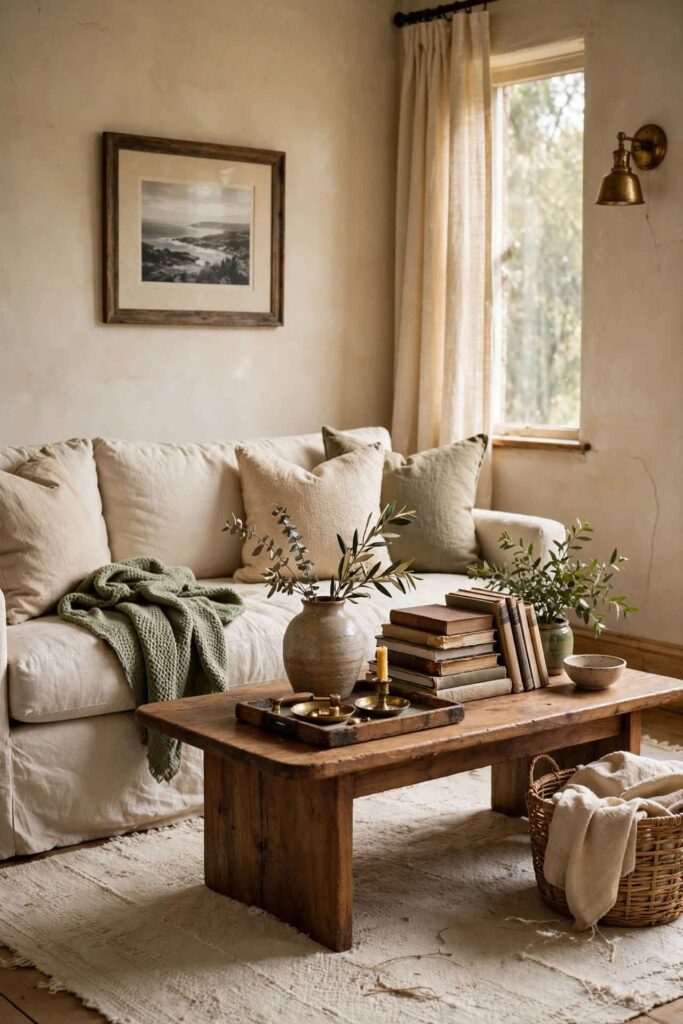
This is the layer that stops a Pottery Barn-inspired living room looking like a showroom. A stack of books you actually read. Handmade pottery. A framed family photo. Something you brought back from a trip. A vintage tray. A plant you’ve kept alive. Pick a few things that are genuinely yours — and then stop. Restraint is the whole trick here. The goal was never to copy a catalog room. It’s a comfortable space that feels like it belongs to you.
Get the Pottery Barn Look for Less
Here’s the thing about the Pottery Barn look: it’s materials and proportion, not labels. And most of it can be recreated for far less. A slipcovered sofa in a washable linen-look fabric usually runs $400–$900 — a designer version starts at $1,500 and climbs. Linen-look curtains go for $30–$80 a pair, woven baskets $15–$40 each, and a Persian-inspired 8 × 10 ft rug typically costs $100–$300. Compare that with a hand-knotted original and the saving speaks for itself.
Aged-brass-look lighting is another easy win — table lamps and sconces in a warm brass finish typically cost $40–$120. And don’t skip the secondhand route for the big pieces: thrift shops, secondhand markets, and online resale are good hunting grounds for solid wood coffee tables and vintage artwork. Look for oak, walnut, or reclaimed wood with visible grain. One good secondhand piece can give the whole room its collected feel.
Warm wood tones do a lot of the work for less. A secondhand oak coffee table or a walnut side table, even with a few scratches, gives the room the same warmth as a new Pottery Barn piece at a fraction of the price.
Then add textured linen throws and one oversized piece of wall art. A washed-linen throw in cream or oatmeal softens the sofa for under $40, and a single large framed print fills the wall the way a gallery of small frames never does. That is pottery barn inspiration on a budget: warm materials, soft texture, and one confident focal point.
Size Guide: Rug, Sofa and Curtains
Scale is what makes this style look expensive, so get the numbers right. In a standard living room, an 8 × 10 ft rug; in a large room, step up to 9 × 12 ft. The front legs of the sofa and chairs should sit on the rug, with 12–18 in of floor showing around the edges. For seating, a three-seater of 84–96 in suits a standard room, while a 72 in loveseat fits a small room better — and aim for a seat depth of 36–40 in if you actually want to lounge.
Curtains follow the same rule: hang the rod 4–6 in above the window frame and 6–12 in wider on each side, panels reaching the floor. And buy enough fabric — 1.5–2 times the window width — so the curtains gather softly instead of hanging flat like a sheet.
Mixing in Mid-Century Pieces
Mid-century modern furniture gets along with the Pottery Barn look because both love warm wood and clean lines. Bring in one statement piece — a lounge chair with tapered legs, a walnut credenza, a low teak sideboard — and keep the rest of the room neutral so it gets to stand out. Then repeat the wood tone once more, in a coffee table or a picture frame, and the mix reads as deliberate instead of accidental.
Keep the palette warm and you’ll be fine: walnut and teak sit comfortably beside cream upholstery, cognac leather, and aged brass. The mistake is going all in — one or two mid-century pieces give the room character. Any more and you’ve tipped into a different style altogether.
Conclusion
At the end of the day, a Pottery Barn-inspired living room isn’t a matching set you buy in one trip. It’s comfort, natural materials, warm neutrals, and pieces with character, put together slowly. Start with what you already own. Then add texture, or better lighting, or a rug that actually grounds the room, or one focal point worth looking at. Big room, small room, traditional, modern — it doesn’t matter. Pick the pieces that fit your life and your budget, and the room will feel relaxed, welcoming, and unmistakably yours.
Frequently Asked Questions
Pottery Barn-inspired rooms mix comfortable furniture, warm neutrals, natural wood, woven textures, relaxed textiles, and a few classic pieces. Casual, layered, timeless — formal is the one thing they’re not.
Cream, ivory, beige, taupe, warm white, soft gray, muted sage, natural brown. Then a little black, aged brass, or cognac leather if the room needs contrast — a little goes a long way.
Start with what people see first: the rug, the curtains, the lighting, the textiles. Then mix in affordable furniture with vintage, secondhand, or pieces you already own. Nobody says you have to replace the whole room at once.
Yes. Scale the furniture to the room, keep the rugs light, pick open-leg pieces, hang the curtains high, and let baskets do the storage. The more floor and surface you can see, the bigger a small room feels.
Relaxed ones — linen, cotton, performance fabric, or slipcovers. Cream, oatmeal, beige, warm gray: all of them play nicely with just about any accent color you add later.
Texture, not color. Linen, cotton, wool, woven fibers, natural wood, ceramic, leather, a rug with something to feel underfoot — layer them and the room gets depth without losing its calm.
Absolutely. A modern sofa or a contemporary lamp sits fine next to a traditional rug, vintage artwork, natural wood, or classic accessories. Mixing periods is usually what makes a room feel personal instead of staged.
Muted traditional patterns, vintage-inspired rugs, natural fibers, or softly textured neutrals. Size it so it connects the main seating pieces — a rug floating alone in the middle of the floor helps nobody.
Keep it simple and useful. A wooden tray, a few books, a ceramic vessel, a small plant — enough to look at, not so much that you can’t put a cup down.
Yes. Floor-length linen or linen-look curtains in ivory, cream, or oatmeal soften the room and add height. Hang them high, let them reach the floor, and the whole window looks more finished.
Layer the textiles, fix the lighting, and choose a few bigger pieces instead of lots of small ones. A soft throw, a textured rug, one warm lamp, a substantial wood table — that’s plenty of cozy without the clutter.
Yes. Removable artwork, freestanding lamps, woven baskets, loose rugs, curtains on renter-friendly hardware, furniture you can take with you. Textiles do the heavy lifting here — they change the atmosphere without touching the property.
Natural oak, medium walnut, reclaimed wood, warm brown finishes. And yes, you can mix wood tones — as long as they share a similar warmth, they’ll get along.
Making everything beige and matching. A room with no contrast just goes flat. Wood grain, a darker accent or two, aged metal, different textiles, some artwork, a few personal pieces — that’s what keeps it alive.
Scale and composition, not quantity. A rug that’s actually the right size, full-length curtains, a substantial coffee table, layered lighting, one large artwork — that combination makes a room feel intentional without expensive accessories.