

Look at most coffee corners and you’ll see the same thing: mugs, filters, beans, a grinder, maybe an appliance or two, all fighting for the same square foot of counter. A glass coffee carafe cuts through that mess in the simplest way — it tidies the station up and puts the coffee itself on show at the same time. Clear glass doesn’t argue with anything. It sits happily in a modern kitchen, a rustic one, a Scandinavian one, a farmhouse one, a minimalist one — and somehow even a Tuesday-morning brew feels a bit more deliberate with it there. The trick isn’t buying more stuff around it. It’s picking the right carafe, then adding just enough around it to frame that clean shape without burying it. That’s what these 15 ideas are for: making a glass coffee carafe the useful brewing essential it is, and the good-looking part of your kitchen too. One thing before we start — this article is about the carafe, the vessel that brews and serves the coffee. For the tray that organises everything around it, see our coffee tray ideas: https://thedecorcraftstudio.com/coffee-tray-ideas/.
In This Article
- Minimalist Glass Coffee Carafe Setup
- Warm Wood and Glass Coffee Station
- Scandinavian Glass Coffee Carafe Display
- Glass Coffee Carafe on a Dedicated Coffee Tray
- Modern Black and Glass Coffee Corner
- Farmhouse Coffee Station With Glass
- Small Apartment Coffee Carafe Setup
- Elegant Coffee Station With Brass Accents
- Glass Carafe With a Cozy Coffee Nook
- Black-and-White Coffee Station
- Rustic Glass Coffee Carafe and Ceramic Mugs
- Glass Coffee Carafe for a Pour-Over Station
- Neutral Luxury Coffee Station
- Open Shelf Coffee Carafe Display
- Simple Everyday Glass Coffee Carafe Setup
- Choosing the Right Carafe
- Frequently Asked Questions
1. Minimalist Glass Coffee Carafe Setup
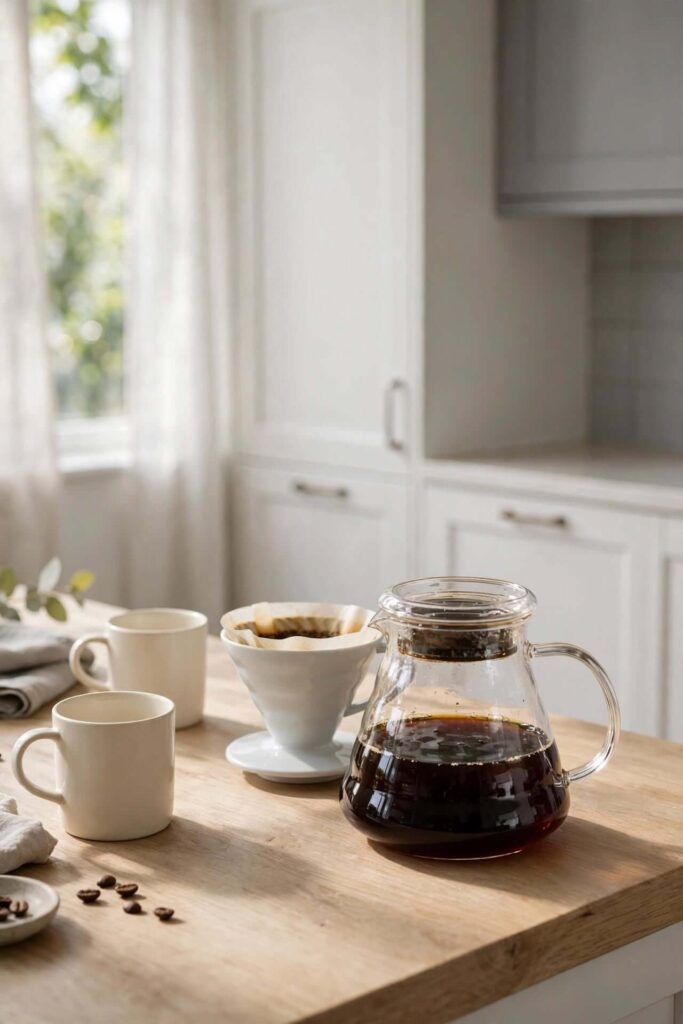
Here’s the thing about minimalism — it only works if one thing gets to be the star. Here, that’s the glass coffee carafe. Set it beside a simple pour-over brewer, one or two neutral mugs, and a small jar of beans on a light countertop, and stop there. White, cream, pale wood, soft gray — that quiet backdrop is doing half the work, letting the clear glass and the dark coffee do the talking. Small kitchen? Even better. Fewer things on the counter means the carafe actually gets noticed instead of disappearing into clutter.
Quick Win: Take everything off the counter that you don’t touch daily, then put what’s left on one small tray. It looks deliberate in about thirty seconds.
2. Warm Wood and Glass Coffee Station
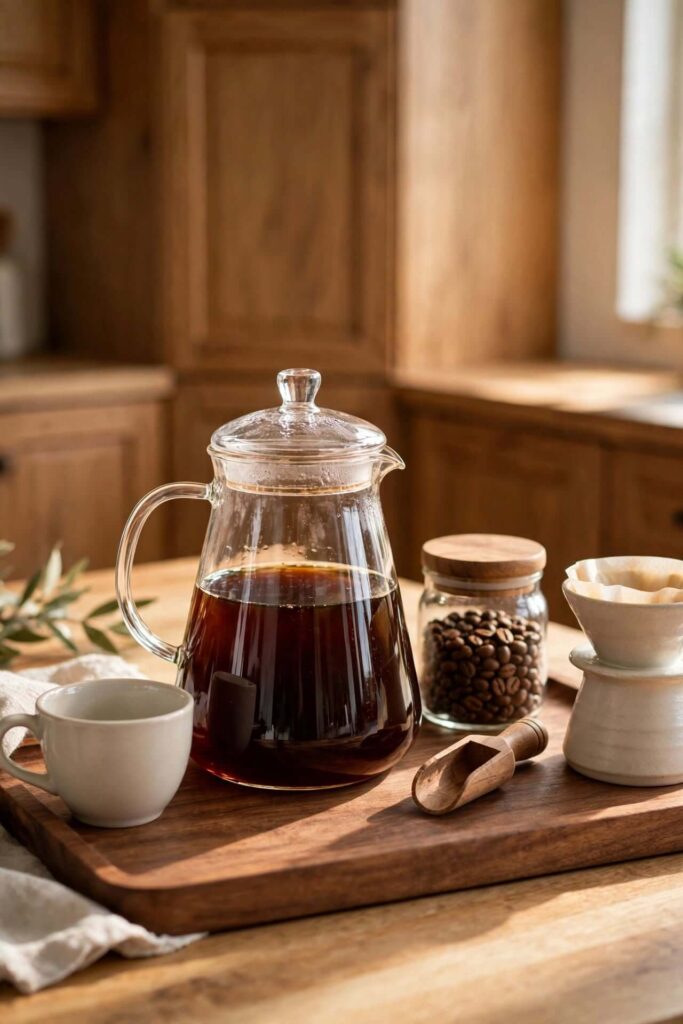
Glass on its own can feel cold. Wood fixes that in one move. Put the glass coffee carafe on an oak or walnut tray, add a wooden scoop, a couple of ceramic mugs, and a small jar of beans — done. Nothing fussy, nothing staged. The grain of the wood against the shine of the glass gives you all the depth you need, no extra decorating required. And if your kitchen already has wood cabinets, a butcher-block counter, or warm floors, this one practically styles itself.
3. Scandinavian Glass Coffee Carafe Display
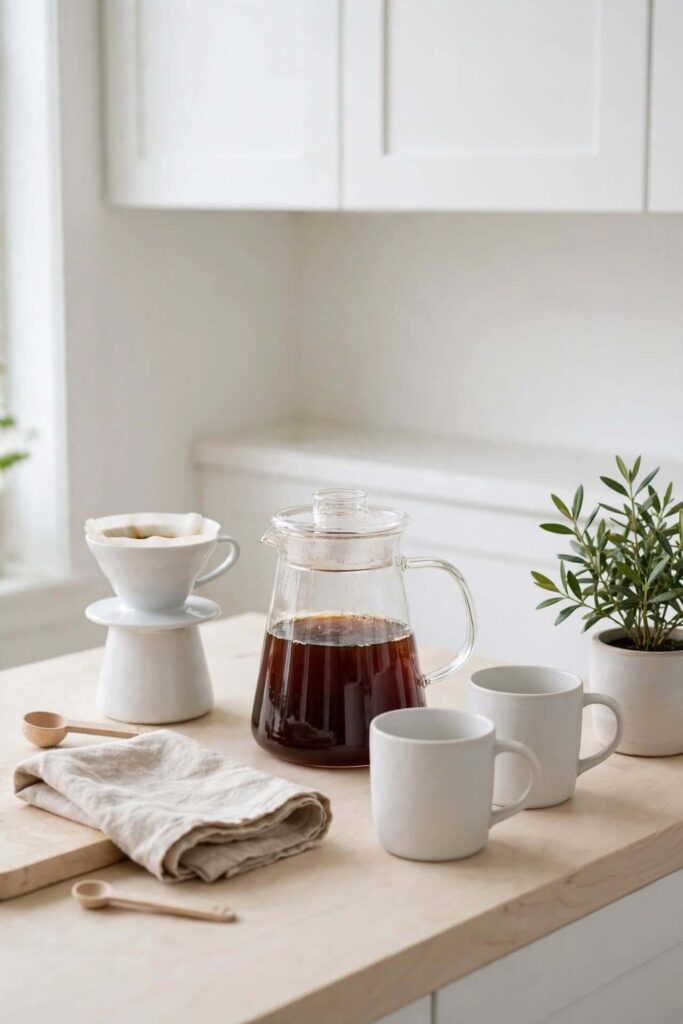
Scandinavian styling is really just three rules: light, useful, and nothing extra. A clear glass coffee carafe fits all three without trying. Pale wood, white ceramics, a bit of linen, one small leafy plant — that’s the whole supporting cast. The carafe keeps the corner feeling airy (it’s mostly see-through, after all), while the dark coffee inside gives your eye somewhere to land. In a bright kitchen it barely feels like a separate coffee area at all. It just belongs there.
4. Glass Coffee Carafe on a Dedicated Coffee Tray
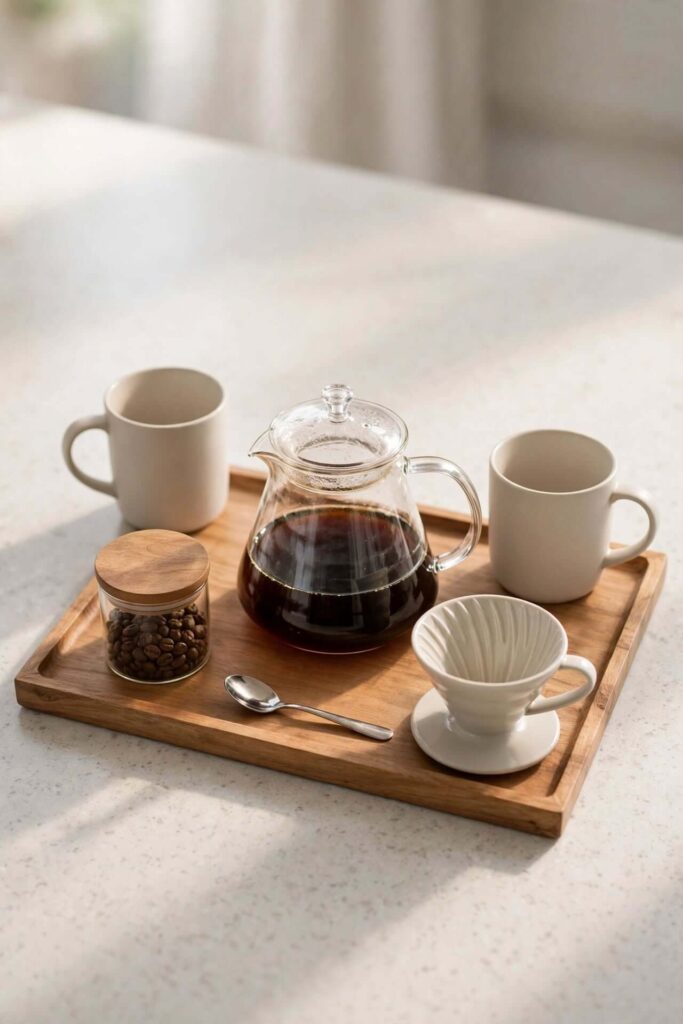
A tray changes everything. Suddenly five loose things are one station. Put the glass coffee carafe right in the middle, then arrange the mugs, the beans, a spoon, and your brewing tool around it. Pick a tray just a touch bigger than the carafe — enough breathing room, not so much that it eats the counter. Renters love this one, and so does anyone who needs the counter clear in a hurry: lift the tray, done. Just remember which one is in charge here. The tray organises. The carafe brews. Style the tray around the carafe, not the other way round.
5. Modern Black and Glass Coffee Corner
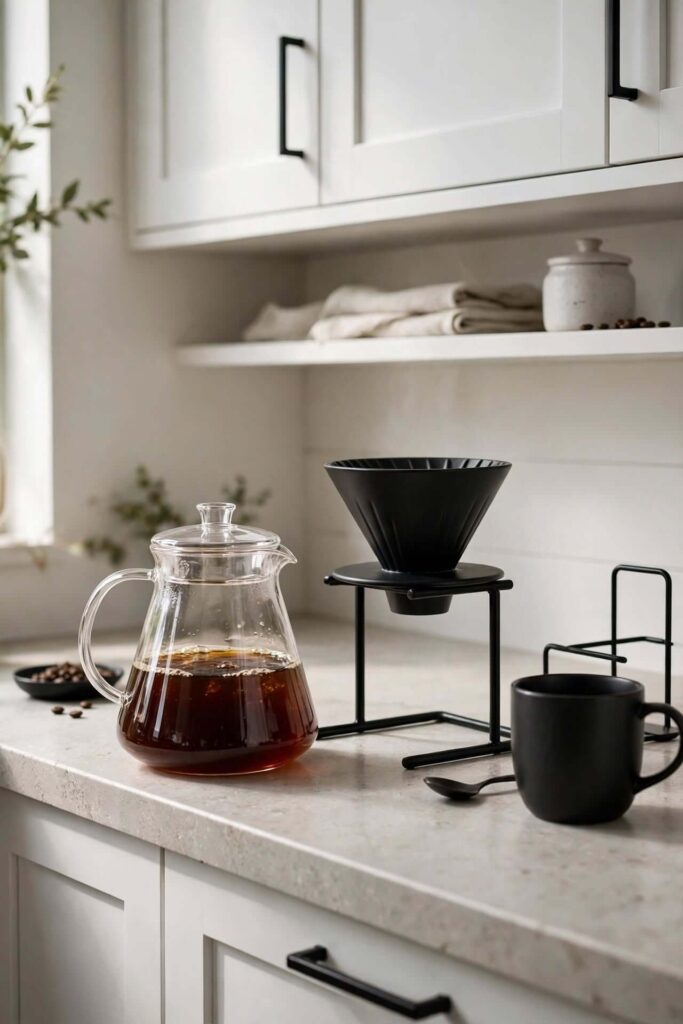
Black and glass is a combination that either looks expensive or looks like a Halloween display. The difference is restraint. A clear carafe, a dark brewer, matte black mugs, a few black metal accents — all of it against a light stone or white countertop, so the glass still pops. Keep the black to the hardware and the mugs and the whole thing reads polished, almost tailored. Got black cabinet handles, dark appliances, charcoal cabinets? Then this look was basically made for your kitchen.
Quick Win: One black accent at a time. A mug, say, or the brewer — then stop and look before you add the next one. Refined beats dark.
6. Farmhouse Coffee Station With Glass
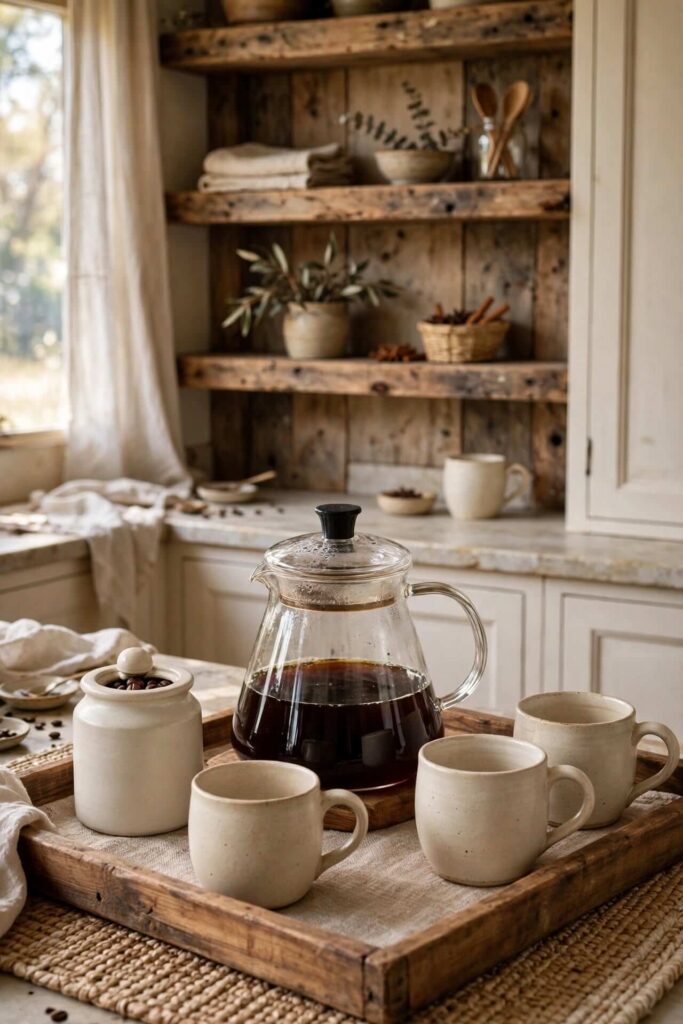
Farmhouse kitchens can go heavy fast — thick wood, chunky ceramics, a lot of texture competing at once. A glass coffee carafe is the thing that lightens it all up. Set it with an aged wooden shelf, cream ceramic mugs, a plain stoneware container, and a few natural wood pieces, and leave some surfaces empty on purpose. The clear glass is the breather in the room, the one light note among all that rustic weight. That’s how a farmhouse coffee station ends up feeling fresh instead of like a theme-park version of itself.
7. Small Apartment Coffee Carafe Setup
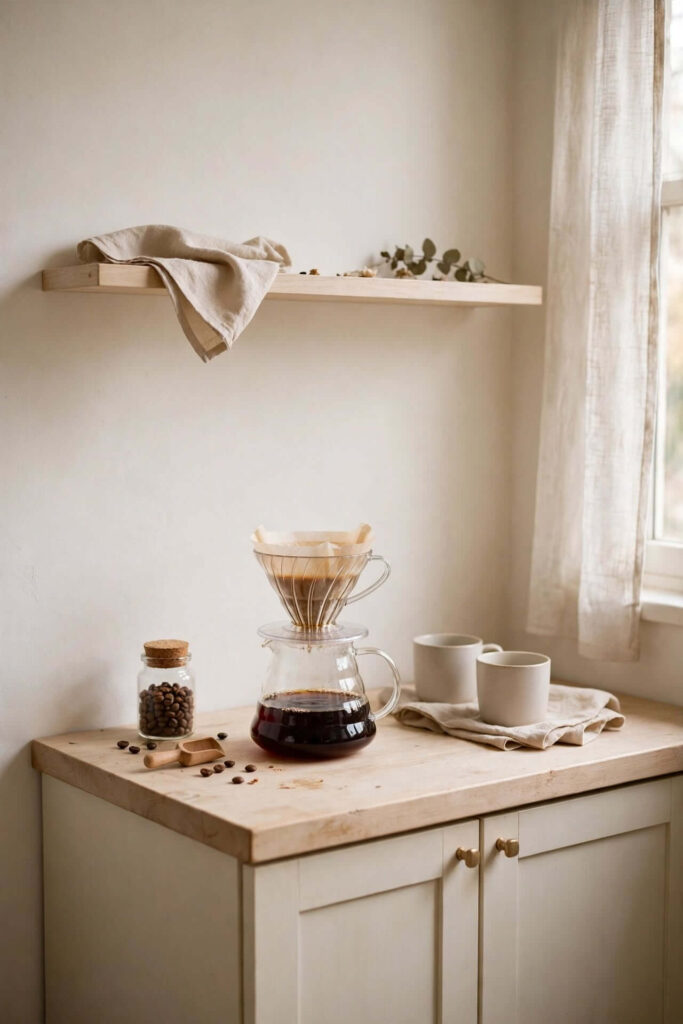
Small counter, small carafe, same good coffee. That’s the whole idea. Pick a compact glass coffee carafe and keep it to the essentials — a brewer, one or two mugs, a small container of coffee. Everything else? Put it on a shelf above the counter, where it’s still in reach but not in the way. Here’s why the glass matters more in a small kitchen than anywhere else: it doesn’t add another big solid block to a space that can’t afford one. You see through it. The counter feels bigger than it is.
8. Elegant Coffee Station With Brass Accents
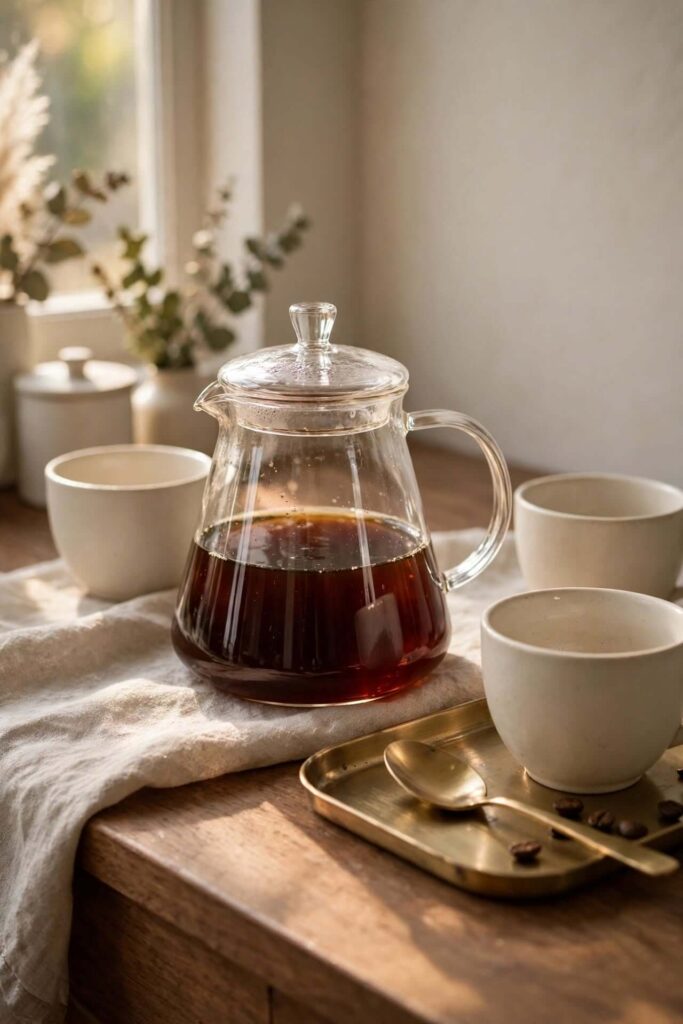
Want the station to feel a little bit fancy without going full formal? Brass. Just a little of it. A glass coffee carafe next to a brass-handled spoon, or sitting on a small brass tray — one warm metallic note is all it takes. Creamy ceramics and medium-toned wood keep it grounded, so it never tips into stiff. The result works two ways: smart enough when friends come over, easy enough for a Wednesday morning.
9. Glass Carafe With a Cozy Coffee Nook
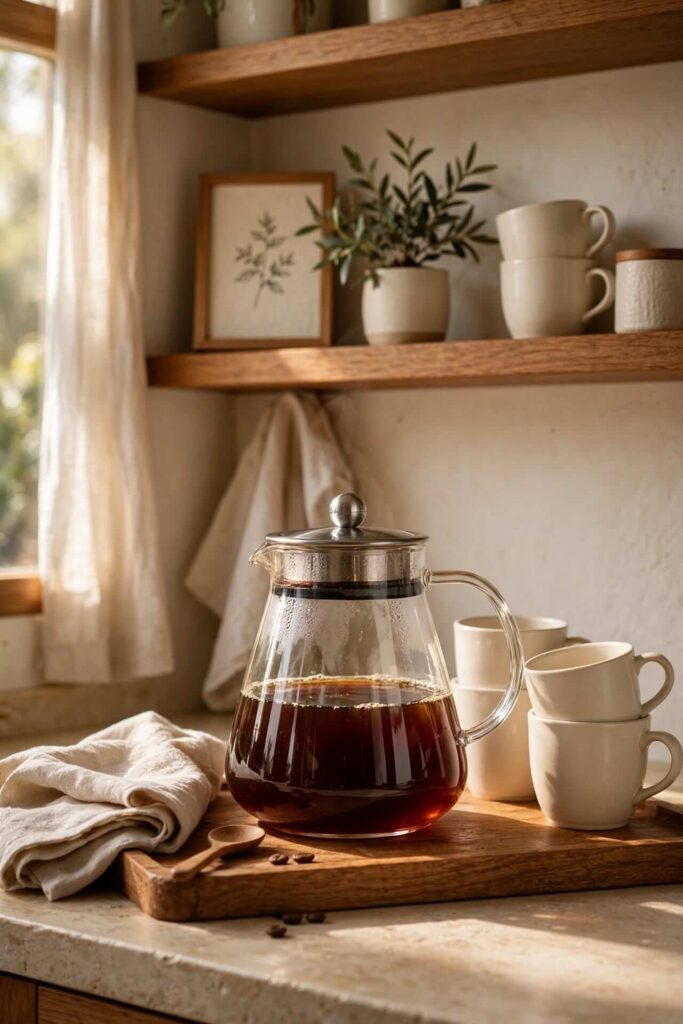
A coffee nook is less about the coffee and more about the pause around it. Tuck the setup near the breakfast table or into a kitchen corner — a small framed picture, a wooden shelf, neutral mugs, a linen towel folded over the edge. The carafe is the practical bit in the middle of it all, the thing you actually use, while everything around it makes the corner feel warm and yours. If morning coffee is the slow part of your day, the part you actually look forward to, this is the setup that fits it.
10. Black-and-White Coffee Station
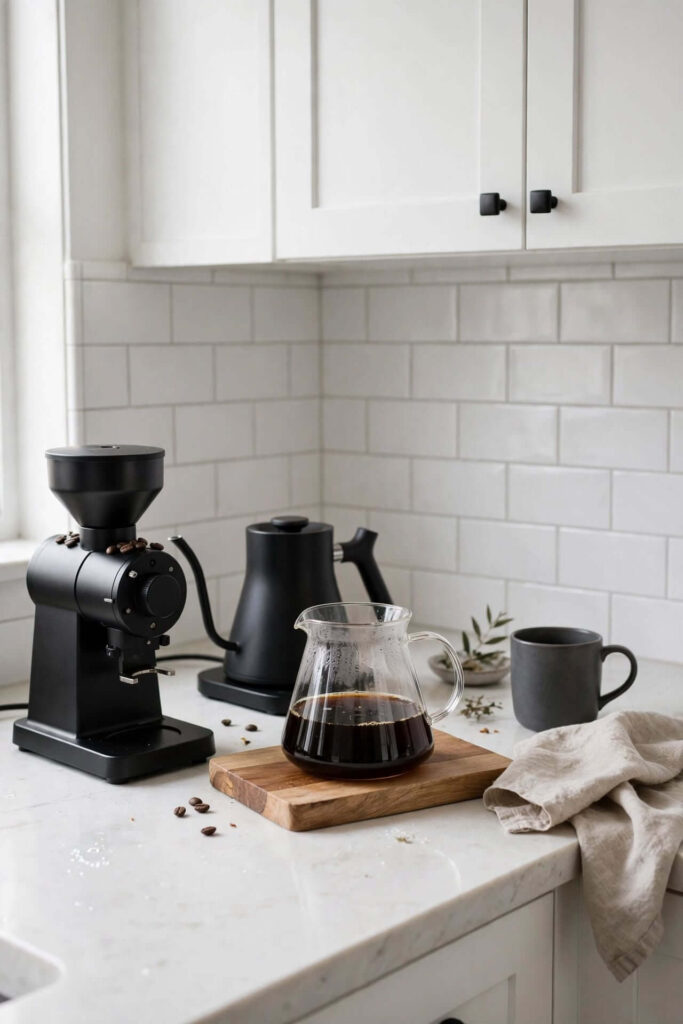
Black and white is the easiest palette to get right and the easiest to make feel cold. The glass coffee carafe is what saves it. Against white tile or white cabinets, with black brewing gear and a charcoal mug, the clear glass sits right between the two strong tones and breaks them up — like a pause in a loud conversation. Add one warm thing, just one: a bit of natural wood, a green plant. And the best part? A two-color palette basically maintains itself. Nothing can clash.
Quick Win: One warm thing. A wooden spoon, a small cutting board — that’s enough to take the edge off a strictly black-and-white corner.
11. Rustic Glass Coffee Carafe and Ceramic Mugs
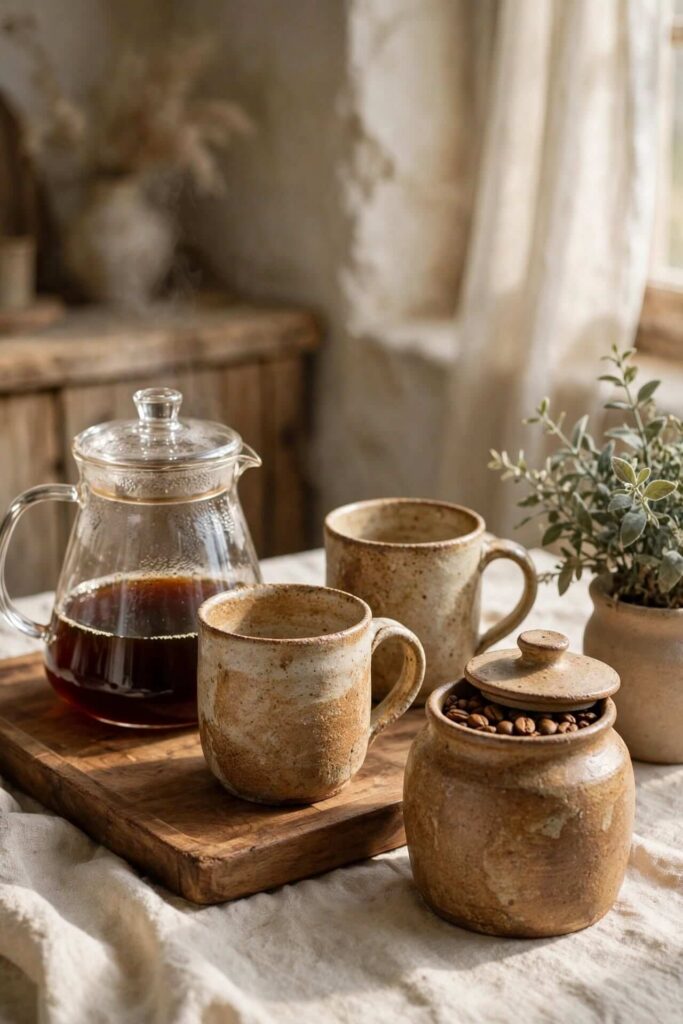
Some coffee stations look bought in one afternoon. This one looks collected — slowly, over years. A plain transparent carafe, stoneware mugs that aren’t quite perfect (that’s the point), a wooden tray, a ceramic jar for the beans. Cream, tan, brown, a muted green if you like — earthy colors that don’t shout. You get all the warmth and character of a kitchen with history, without piling on the decoration to fake it.
12. Glass Coffee Carafe for a Pour-Over Station
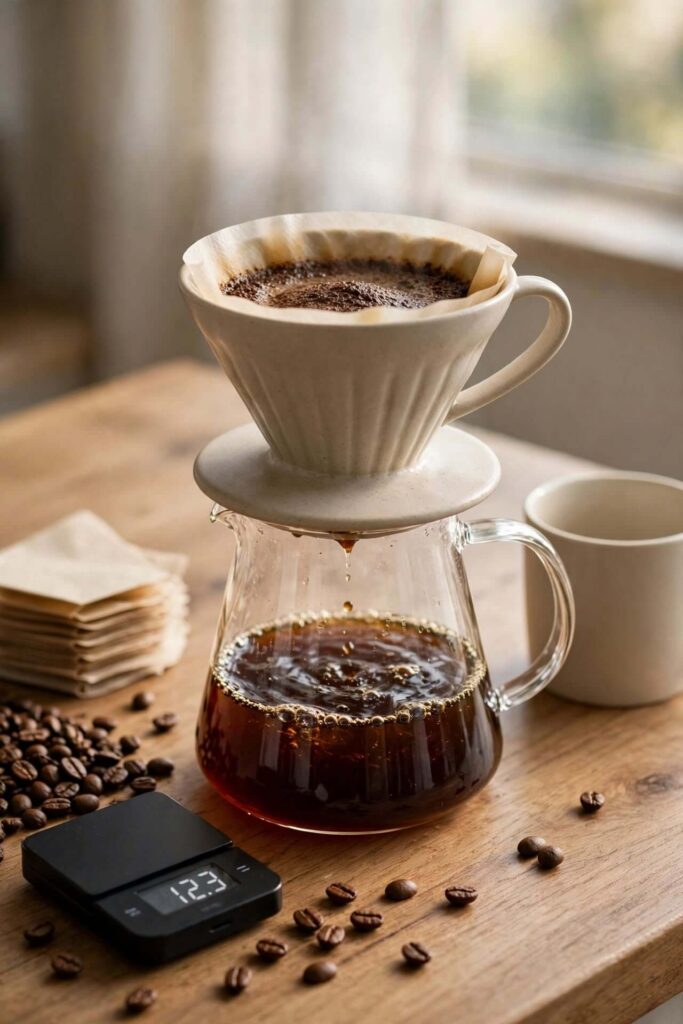
If you brew pour-over, why hide the best part? Let the brewing be the display. Sit the glass coffee carafe under a ceramic or glass dripper and watch the coffee drip in — that’s the show. Keep the filters, the beans, and the scale close by, but tidy. Clear glass earns its keep here twice over: you can see exactly how much coffee you’ve got, and the whole ritual is on view while it happens. The numbers, for reference: a coffee-to-water ratio of about 1:15 to 1:17 — for example, 30 g of coffee to 450–500 ml of water — with a medium grind, about the texture of coarse sand. Pour in slow circles, let the coffee bloom for 30–45 seconds, and aim for a total brew time of 3–4 minutes.
13. Neutral Luxury Coffee Station
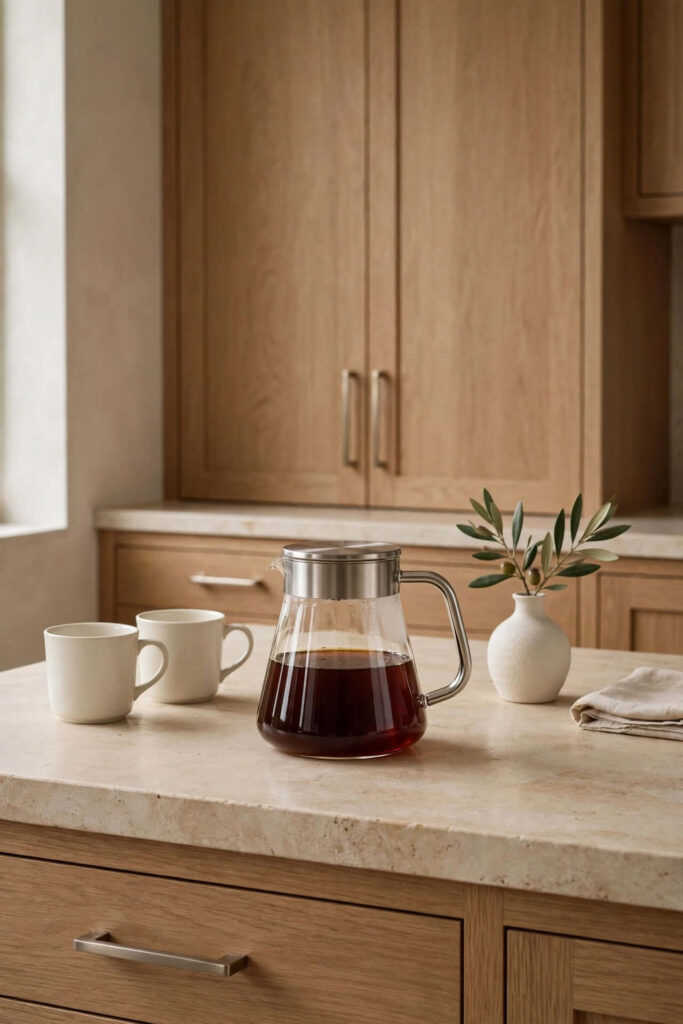
Luxury doesn’t have to mean gold taps and marble everywhere. Sometimes it’s just… restraint, done well. A clear glass coffee carafe with ivory ceramics, beige stone, warm oak, and a touch of brushed metal — nothing loud, nothing crowded. Leave the counter mostly empty and let the materials do the talking: good proportions, good surfaces, nothing fighting for attention. In a contemporary kitchen with an understated interior, the coffee corner just melts in. Quietly expensive, that’s the feel.
14. Open Shelf Coffee Carafe Display
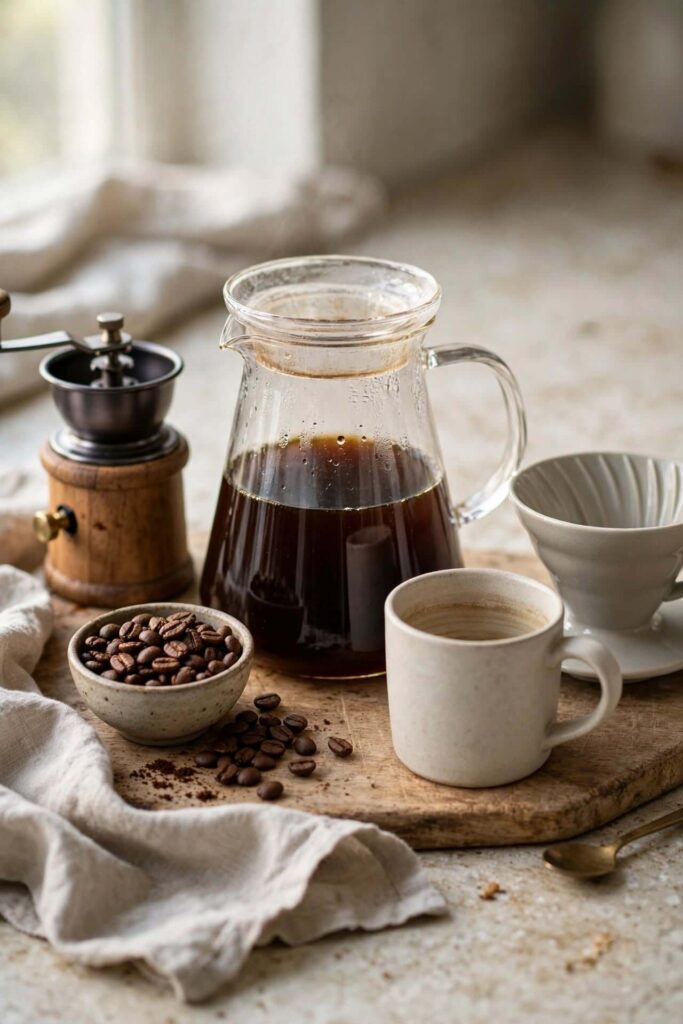
Open shelves are either a display or a mess — there’s not much middle ground. The trick is treating the two levels as one picture. Glass coffee carafe on the counter below, mugs and equipment beside it; matching ceramics and a small plant on the shelf above. Repeat the same colors on both levels and suddenly it all hangs together. You get a coffee station that looks decorated and still works like a kitchen — everything you need is right there, no cupboard-diving required.
15. Simple Everyday Glass Coffee Carafe Setup
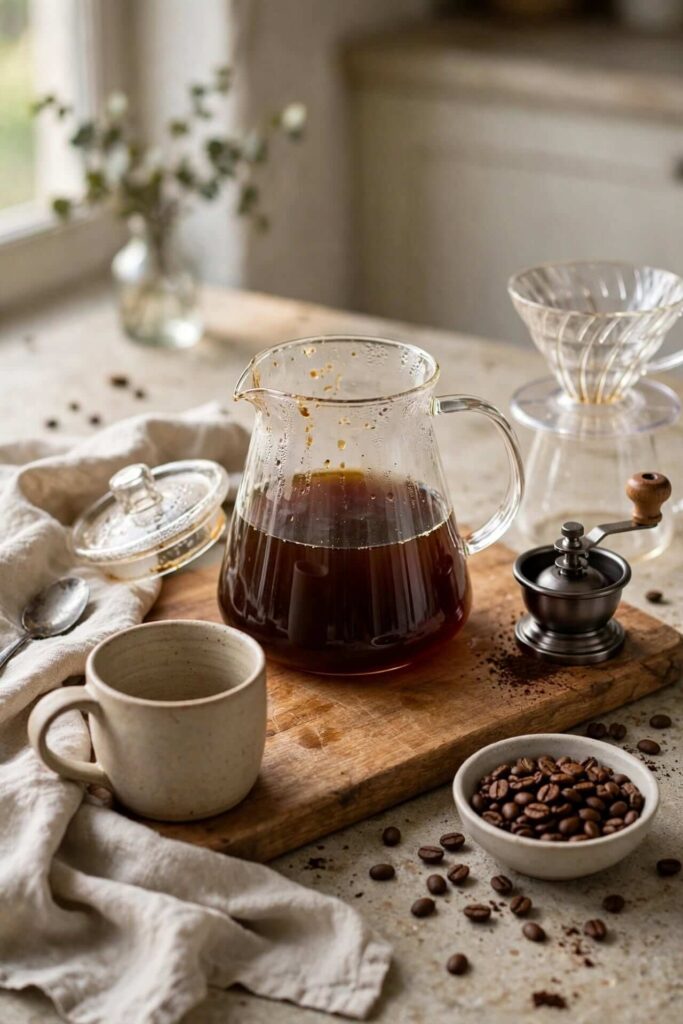
Not every coffee station needs to look styled. Some of the best ones just look… used. A glass coffee carafe next to your favorite mug, the grinder, the beans, a small wooden board. No elaborate display, no theme. The only rule is space — give each thing room to breathe and the whole counter relaxes. It’s practical, it’s approachable, it takes about ten seconds to tidy, and for a busy household that’s worth more than a perfect photo.
Quick Win: Stop hiding the everyday stuff in different cupboards. Put it together on one small tray and routine coffee gear suddenly looks like a station.
Choosing the Right Carafe
Start with size. It’s the decision that matters most, and it’s the easiest to get wrong. A 600 ml glass coffee carafe (about 20 oz) brews enough for two to three mugs and suits a one- or two-person household; a 1 L glass coffee carafe (about 34 oz) serves four to five mugs and fits a family breakfast table. Anything larger than 1.5 L is hard to pour neatly and cools faster, so it only makes sense for entertaining.
Then check what it’s made of. Most glass coffee carafes are borosilicate glass, which handles sudden temperature changes well and feels light in the hand. Cheaper soda-lime glass is heavier and more likely to crack from heat shock — so check the manufacturer’s guidance before you pour boiling water into it.
And be honest with yourself about heat. Glass alone does not hold heat for long: a single-wall carafe keeps coffee hot for roughly 20–30 minutes. Pre-warm it with hot water before brewing — it helps — and use a warming plate or a double-wall design if coffee needs to stay hot longer. One hard rule: never put a glass carafe directly on a flame or an electric coil unless the manufacturer states it is stovetop-safe. Most are not.
Conclusion
A glass coffee carafe is more than a thing that holds coffee. Done right, it’s the natural focal point of the whole corner. Minimalist, rustic, Scandinavian, modern, warmly collected — whatever your style, the formula is the same: glass, ceramics, wood, and a few restrained accessories, put together on purpose. You don’t need all fifteen ideas. Honestly, please don’t try all fifteen. Pick the details that fit your space, your brewing habits, your personality, your budget — and build a coffee corner you actually enjoy standing at every morning.
Frequently Asked Questions
Holding and serving brewed coffee — that’s its job. A glass coffee carafe also works directly with pour-over brewing systems, so the coffee drips straight into the carafe before you serve it.
Yes, many glass carafes are designed for everyday brewing and serving. Just check the manufacturer’s temperature and heat-resistance specifications before exposing the carafe to high heat.
Keep it simple. Pair the carafe with mugs that go with it, a coffee brewer, the beans, and a small tray — that’s enough. Natural wood and neutral ceramics work especially well with transparent glass.
Not for long, honestly. A basic single-wall glass carafe keeps coffee hot for roughly 20–30 minutes — noticeably less than a thermal carafe. Pre-warming the carafe with hot water before brewing adds a few minutes, and a warming plate or a double-wall design holds heat longer. If coffee needs to stay hot for over an hour, brew smaller batches more often rather than leaving a full carafe standing.
Almost anything — that’s the advantage of clear glass, it’s visually neutral. Cream, white, black, natural wood, earthy tones, and muted greens are particularly easy to combine.
Yes. Many pour-over setups are specifically designed to brew directly into a glass carafe — just make sure the size and shape of the carafe are compatible with your brewer. A 600 ml carafe suits a one- to two-cup dripper, while a 1 L carafe suits larger brewers. Use a coffee-to-water ratio of about 1:15 to 1:17 with a medium grind.
Wash it according to the manufacturer’s instructions, and pay special attention to coffee residue around the base and narrow openings — that’s where it builds up. Regular cleaning helps prevent lingering coffee oils and odors.
Absolutely. Its transparent appearance can feel visually lighter than bulky opaque equipment — in a small kitchen, that matters. Choose a compact size and keep only your everyday coffee essentials on the counter.
Coordination, not quantity. Matching neutral ceramics, quality-looking natural materials, a wooden tray, restrained metal accents, and good organization — put those together and the whole station looks far more elevated than what you spent on it.
Yes — and it might be the best place for glass in the whole kitchen. It looks especially appealing alongside reclaimed wood, stoneware, woven textures, and warm neutral colors, and the contrast stops a rustic coffee station from looking too heavy.
Overcrowding, mostly. Too many mugs, containers, signs, and decorative accessories, and the carafe disappears. Give it enough negative space to remain the visual focal point — empty counter around it is doing real work.
Some are dishwasher safe while others require hand washing. Always check the specific product’s care instructions before putting it in a dishwasher.
Position it centrally on a tray or countertop and keep surrounding items visually simple. Dark coffee against a light neutral background does the rest — the contrast naturally draws attention to the carafe.